John Wilkes Booth and the Devil
06 Monday May 2013
Posted in Lincoln Wonk
≈ Comments Off on John Wilkes Booth and the Devil
06 Monday May 2013
Posted in Lincoln Wonk
≈ Comments Off on John Wilkes Booth and the Devil
05 Sunday May 2013
Posted in Lincoln Wonk
≈ Comments Off on Treasure trove from 1893
Confederate Veteran magazine, over the centuries, carried first-person narratives from hundreds of important rebel eyewitnesses.
The editors at Confederate Veteran were so kind as to share an accessible collection of fascinating back issues from 1893-1932.
They are posted on this University of Pennsylvania site: http://onlinebooks.library.upenn.edu/webbin/serial?id=confedvet
04 Saturday May 2013
Posted in Lincoln Wonk
≈ Comments Off on Lincoln more popular than Washington
There are 2,972 biographies of George Washington, but 5,796 of Abraham Lincoln.
If you’re counting books that are simply about Lincoln, it’s much higher — about 16,000. That’s enough books to stack three stories high. The Center for Education and Leadership at the National Park Service’s Ford’s Theatre complex has done just that. The staircase at the new center winds around a wide stack of Lincoln’s books that reach 34 feet high.
Two hundred biographies were published in 2009 alone — the 200th anniversary of President Lincoln’s birth.
Sources: WSJ.com, World Cat
03 Friday May 2013
Posted in Lincoln Wonk
≈ Comments Off on Two graves for Stonewall Jackson
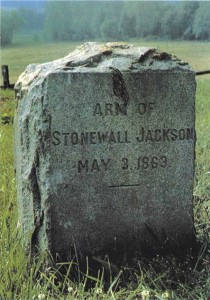
Confederate General Stonewall Jackson died on May 10, 1843, but his arm had already received a Christian burial.
When Jackson was accidentally shot by his own troops on this day in 1863, his arm was amputated to save his life. His chaplain couldn’t bear to see the general’s arm thrown on a pile of amputed limbs from the Battle of Chancellorsville, so he gave the arm a Christian burial in a private cemetery nearby.
Gen. Jackson died of pneumonia the next week. His body was sent to his family in Lexington, Va. — minus one arm.
Mrs. Jackson decided not to exhume the arm because it received a Christian burial.
Unfortunately, Union soliders reportedly dug it up in 1864, possibly moving it to another location. In 1903, one of Jackson’s staff officers erected this granite marker in the cemetery to commemorate the arm. Ellwood Manor Cemetery is near the National Military Park at Fredericksburg and Spotsylvania in Virginia.
Sources: The Surratt Courier, NPR.org
02 Thursday May 2013
Posted in Lincoln Wonk
≈ Comments Off on President Lincoln’s mourning cards
01 Wednesday May 2013
Posted in Lincoln Wonk
≈ Comments Off on Metro police had no days off
The Washington City police who searched for John Wilkes Booth were accustomed to working 12-hour shifts seven days a week. That was their normal schedule.
The patrolmen were paid $40 a month — less than day laborers and less than half what a skilled mechanic could command. Sergeants made a little more — $600 a year.
Source: “Law and Order in the Capital City: A History of the Washington Police 1800-1866 by Kenneth G. Alfers.
30 Tuesday Apr 2013
Posted in Lincoln Wonk
≈ Comments Off on Lincoln not the first to lie in state
President Lincoln was not the first person to be accorded the honor of lying in state in the Capitol Rotunda.
Henry Clay, speaker of the House of Representatives, was the first when he died in 1852.
President Lincoln was second, and 11 other presidents followed him, along with selected senators and military commanders, the unknown soldiers for four wars, FBI Director J. Edgar Hoover and Pierre L ‘Enfant, who designed the layout for Washington, D.C.
29 Monday Apr 2013
Posted in Lincoln Wonk
≈ Comments Off on Lincoln saw Booth at Ford’s before
President Lincoln attended 10 performances at Ford’s Theatre: “La Figlia Del Regiment” in March 1862, “Fanchon, the Cricket” in October 1863, “The Marble Heart” starring John Wilkes Booth in November 1863, “Henry IV” starring James H. Hackett as Falstaff on December 14 and again on December 15, 1863, “The Merry Wives of Windsor” starring Hackett on December 17, 1863, “King Lear” in April 1864, a June 1864 concert, a Treasury Department concert in April 1864 and “Our American Cousin” on April 14, 1865.
Source: Civilwar.org
28 Sunday Apr 2013
Posted in Lincoln Wonk
≈ Comments Off on Mr. Lincoln writes a fan letter
President Lincoln wrote a fan letter to his favorite Shakespearian actor James H. Hackett.
He invited Hackett to the White House, an invitation the actor accepted.
He liked Hackett’s rendition of Falstaff so well that he attended four times.
For more on Lincoln’s love of Shakespeare, go to http://www.folger.edu/template.cfm?cid=3137
27 Saturday Apr 2013
Posted in Lincoln Wonk
≈ Comments Off on Booth didn’t need a ticket
John Wilkes Booth never bought a ticket on the evening of April 14 because he was a long-time friend of theater owner John T. Ford. Here are the prices for the paying customers:
Family Circle tickets, for 25 cents, admitted the bearer to the third-floor balcony, where patrons sat on high-backed benches.
Dress Circle tickets, at 75 cents, meant the bearer sat on a cane-bottomed chair on the second-floor balcony, the same level as the presidential box.
Orchestra Level tickets, at $1, were among the best seats in the house. Seats ran from directly behind the orchestra pit and to the back of the main floor.
Tickets for boxes cost $10 for upper boxes and $6 for the lower boxes. The grandiose boxes were actually the worst seats in the house because they faced away from the stage and toward the audience. The idea was to allow audience members to gawk at the celebrities who rented them.
Thirsty playgoers could duck into the adjoining Tatavull’s Saloon to wet their whistles at intermission.