• About Kathryn Canavan

Lincoln Wonk

~ Glimpses of a leader

Lincoln Wonk

Author Archives: Lincoln Wonk

The hand that signed the Emancipation Proclamation

06 Saturday Apr 2013

Posted by Lincoln Wonk in Lincoln Wonk

≈ Comments Off on The hand that signed the Emancipation Proclamation

The hands of Abraham Lincoln portrayed in the 19-foot-tall statue that is the focal point of the Lincoln Memorial were based on hand casts taken in 1860.

Sculptor Daniel Chester French studied the work of Leonard Wells Volk, who convinced Lincoln to sit for him after he won the Republican nomination for president.

When Volk casted Lincoln’s hands, the right one was swollen, a result of constant handshaking on the campaign trail.

Volks sold 33 casts of Lincoln’s hands for $1,500 each.

His subscribers included sculptor Augustus Saint-Gaudens, Dracula novelist Bram Stoker and assistant secretary of state J.L. Cadwalader.

Lincoln’s rocking chair pre-CSI

05 Friday Apr 2013

Posted by Lincoln Wonk in Lincoln Wonk

≈ Comments Off on Lincoln’s rocking chair pre-CSI


Rocking Chair

Photo courtesy of Chicago History Museum


The rocking chair President Lincoln used at Ford’s Theatre has a a large, dark stain in the head area, but it is not the president’s blood.

President Lincoln bled very little at the theater. The stain, which has turned to a resin in the nearly 150 years since the assassination, was probably hair oil.

The Fords moved the elaborate chair out of the theater because ushers and actors were sleeping in it, and their hair oils and pomades were staining the red silk damask upholstery.

After that, the rocker was used only for special events, such as Mr. Lincoln’s visit.

The black walnut chair was held by the government for many years, until Harry Ford’s widow petitioned the government for its return.

She sold it at auction in New York in 1929.

Henry Ford, the automobile magnate, bought it for $2,400. Today it is on display in a climate-controlled case at the Henry Ford Museum in Dearborn, Mich.

The springs supporting the chair are magnetic. Knotted lashing ties control the tension in the seat. There is some very lightweight blue paper on the bottom of the seat frame.

Source: Henry Ford Museum, Dearborn, MI.


Grants headed for New Jersey

04 Thursday Apr 2013

Posted by Lincoln Wonk in Lincoln Wonk

≈ Comments Off on Grants headed for New Jersey

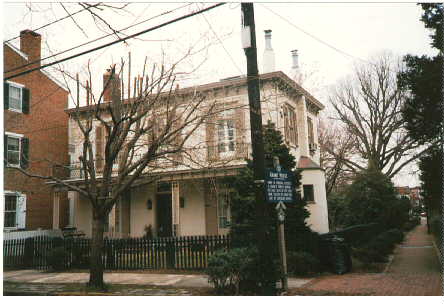
burlington houseGen. Ulysses Grant and his wife Julia kept a home in Burlington, N.J. to escape the politics and war in Washington. The house, still standing at 309 Wood Street, is a two-story stucco home with French windows on both floors and an expansive front porch topped with delicate wrought-iron railing.

The couple was headed to Burlington on the night of April 14 when they were met at a ferry stop in Philadelphia and informed of the assassination.

The general escorted his wife to Burlington, then returned to Washington, D.C. by train.


Moving day for two presidents

03 Wednesday Apr 2013

Posted by Lincoln Wonk in Lincoln Wonk

≈ Comments Off on Moving day for two presidents

Abraham Lincoln and Jefferson Davis left their homes on the same day to move to their capitals – February 11, 1861.  They each had 60 days between their departures for Washington or Richmond and the first volley of war at Fort Sumter.

In President Lincoln’s inaugural address, he firmly stated that the states that seceeded must rejoin the Union.

President Davis, in his installation address, said the time for compromise had passed. “The South is determined to maintain her position, and make all who oppose her smell Southern powder and feel Southern steel.”

Source:” How the North Won” by Herman Hattaway and Archer Jones

Rats and souvenir hunters

02 Tuesday Apr 2013

Posted by Lincoln Wonk in Lincoln Wonk

≈ Comments Off on Rats and souvenir hunters

There were no Secret Service guards or metal detectors at the Lincoln White House.

The lower story, where the kitchen was, smelled of mildew. Rats were a nuisance there.

Until President Lincoln’s secretary convinced him to limit visiting hours, people began visiting before breakfast and kept arriving until late at night.

After Mary Lincoln redecorated the public rooms, souvenir hunters snipped pieces of curtain tassels and took the curtain cords as souvenirs. One person cut nearly two feet out of a new silk curtain.

Source: Ronald D. Reitveld, The Lincoln White House Community, Journal of the Abraham Lincoln Association


Only Booth’s legend lived on

01 Monday Apr 2013

Posted by Lincoln Wonk in Lincoln Wonk

≈ Comments Off on Only Booth’s legend lived on

John Wilkes Booth’s body was returned to his family for burial in 1869, but skeptics continued to believe Booth was alive for another half century.

Despite the identifying marks – his three-letter tattoo on his left hand and a distinct scar on his neck – some people still didn’t believe Booth was shot to death by Boston Corbett at the Garrett Farm on April 26, 1865.

Even sworn statements from witnesses couldn’t quell the rumors, which had Booth living in Texas and Oklahoma under an assumed name well into the next century.

This photo from the Hagley Museum and Library shows a supposedly mummified Booth on display in a sideshow, probably in the 1920s: http://cdm16038.contentdm.oclc.org/cdm/ref/collection/p268001coll8/id/180

Lincoln, Lincoln, bo Bincoln, fee fy mo Mincoln, Lincoln!

31 Sunday Mar 2013

Posted by Lincoln Wonk in Lincoln Wonk

≈ Comments Off on Lincoln, Lincoln, bo Bincoln, fee fy mo Mincoln, Lincoln!

President Lincoln greatly disliked his given name “Abraham,” and he liked the nickname “Abe” even less. No one called him Abe in his presence.

Those he had business dealings with called him Mr. Lincoln. Even Mary sometimes  referred to him as Mr. Lincoln.

Source: Personal Recollections of Abraham Lincoln by Noah Brooks, Harper’s New Monthly Magazine, July 1865

Mr. Lincoln, inventor-president

30 Saturday Mar 2013

Posted by Lincoln Wonk in Lincoln Wonk

≈ Comments Off on Mr. Lincoln, inventor-president

Abraham Lincoln is the only U.S. president to hold a patent.

He received Patent 6469 for “A Device for Buoying Vessels Over Shoals” in 1849.

The invention was a set of bellows, a larger version of fireplace bellows, that attached to the hull of a ship just below the water line. The idea was the bellows would be filled with air when the ship reached a shallow spot, and the air would make the ship float higher. It was never commercially produced.

A Springfield mechanic helped design the model, which Congressman Lincoln  whittled with his own hands.  A replica is on display at the Smithsonian Institution National Museum of American History. The original is too fragile to display.

Source: americanhistory.so.edu


Bad luck of Biblical proportions

29 Friday Mar 2013

Posted by Lincoln Wonk in Lincoln Wonk

≈ Comments Off on Bad luck of Biblical proportions

Ford’s Theatre started out in life as a church.

The large brick building was constructed in 1833 as the home of the First Baptist Church of Washington.

When Catholic, Lutheran and Evangelical immigrants moved into the neighborhood, the Tenth Street Baptists decided to sell and merge with another Baptist congregation.

The building sat vacant until John T. Ford leased it for use as a theater in December 1861. The theater was greeted with protests from citizens, who thought no good would come from turning a house of God into a house of entertainment.

After some trial shows, Ford decided he could make a go of it despite the nay-sayers.

He renovated the building and reopened it as Ford’s Antheneum in March 1862. That December it was gutted by an accidental fire.

Ford still believed his theater could work. On August 27, 1863, he opened a well-engineered modern theater with a seating capacity of 2,500. Ford’s New Theatre was a runaway success until John Wilkes Booth shot the president.

Ford tried to reopen after the assassination, but Secretary of War William Stanton shut him down. The government leased the building for $1,500 a month, until Congress agreed to buy it for $88,000 in 1866. It added floors for use as offices.

The building’s string of bad luck wasn’t over. Without warning, at 9:30 a.m. on Friday, June 9, 1893, all three floors fell like a house of cards after a basement support gave way.

Employees and their desks slid into the breach. Every window was blown out. A cloud of dust rose to the roof. Twenty-two were killed; 68 were injured.

Source: Ford’s Theatre files and Ford’s Theatre.org
Medal of Honor winner

28 Thursday Mar 2013

Posted by Lincoln Wonk in Lincoln Wonk

≈ Comments Off on Medal of Honor winner

obeirne-e1351430845552

Gen. James R. O’Beirne had already won the Medal of Honor before he assisted Secretary William Stanton on assassination night and pursued John Wilkes Booth.

O’Beirne, a lawyer and an Irish immigrant, won his medal for his bravery at Chancellorsville in 1863, where he was a captain with a New York regiment nicknamed “The Irish Rifles.”

He was shot through the lungs, shot in the leg, hit by shells on both sides of his head and left on the battlefield for three days.

During the war, Gen. O’Beirne served as provost marshal for the District of Columbia. Aftewards he was appointed register of wills in Washington, D.C. For many years, he was the Washington correspondent for the New York Herald. Then he moved back to New York City, where he was in charge of immigration at Ellis Island.

He died in 1917 at age 77.

Source: Editor and Publisher magazine, Feb. 24, 1917, and  Ford’s Theatre files.


← Older posts
Newer posts →

♣ Email Lincoln Wonk

Contact Kathryn at mail@kathryncanavan.com

♣ RSS Feed

 Subscribe in a reader

♣ Newsletter

Enter your email to get daily Lincoln Wonk updates:

♣ Recent Posts

  • A rebel widow visits the Lincolns
  • Seward invests in real estate
  • More lives than a cat
  • Marfan’s rumors are unfounded
  • New president missed his wife

♣ Links

  • Abraham Lincoln Presidential Library and Museum
  • Abraham Lincoln Research Site
  • Dr. Mudd House Museum
  • Ford's Theatre National Historic Site/National Park Service
  • Surratt Society
  • The Center for Civil War Photography
  • The Lincoln Institute

♣ Archives

  • March 2014 (30)
  • February 2014 (28)
  • January 2014 (32)
  • December 2013 (31)
  • November 2013 (30)
  • October 2013 (30)
  • September 2013 (29)
  • August 2013 (1)
  • July 2013 (30)
  • June 2013 (27)
  • May 2013 (31)
  • April 2013 (30)
  • March 2013 (18)
  • January 2013 (1)

©2013 Kathryn Canavan